Everyone is talking about BIM. Architects, engineers, universities, and governments present it as the inevitable future of construction. But there is a question few dare to ask out loud: who cannot afford it?
While large firms and multinational contractors adopt Building Information Modeling with enthusiasm, thousands of small and medium construction companies in Mexico, Peru, Chile, Ecuador, and the rest of Latin America watch from the outside, calculating whether the technological leap is worth the cost.
This article is not written to convince you that BIM is good or bad. It is written to give you the real facts you need to decide for yourself.
What Is BIM and Why Is It Growing So Fast?
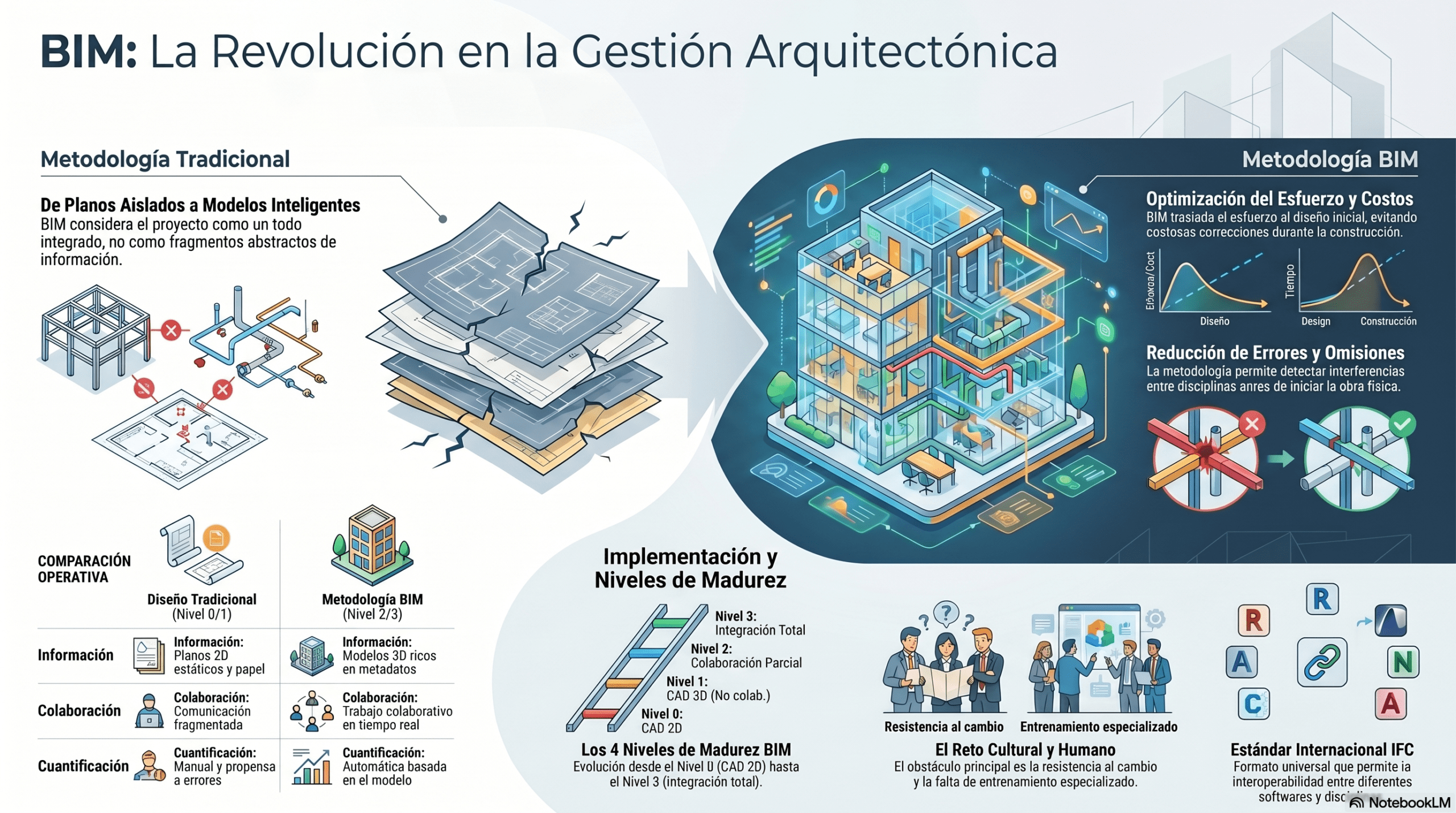
BIM (Building Information Modeling) is a working methodology that centralizes all information about a construction project — design, structure, systems, costs, schedules, materials — into a single intelligent three-dimensional digital model.
Unlike traditional 2D blueprints, a BIM model does not just show what a building looks like: it contains data about every construction element, its dimensions, estimated cost, structural behavior, and even its carbon footprint.
The reasons for its growth are concrete:
- Reduces design errors before they reach the construction site
- Improves coordination between architects, engineers, and contractors
- Allows simulation of building behavior before breaking ground
- Simplifies maintenance management once the project is complete
- Several regional governments now require it in public tenders
Chile was a pioneer in the region by incorporating BIM into public infrastructure projects as early as 2016. Mexico, Peru, and Colombia have followed with gradual adoption plans. Regulatory pressure is real and growing.
The Promises of BIM: What Universities and Data Say
Academic literature is enthusiastic. Theses from the University of Chile, UNAM, Universidad Federico Villarreal in Peru, and Universidad Politécnica Salesiana in Ecuador document measurable benefits when BIM is properly implemented:
- Up to 40% reduction in hours spent on design corrections
- Significant decrease in change orders during construction, which are the main cause of cost overruns
- Better communication among project stakeholders through a shared, real-time updated model
- Integration with Lean Construction methodologies to eliminate waste in the production process
A 2025 master’s thesis from UNFV (Lima) on BIM combined with Lean Construction principles in educational infrastructure concluded that both methodologies together produce a statistically significant improvement in project performance.
On paper, the case is solid. On the job site, the story is more complicated.
The Other Side: What Theses Do Not Always Say
The Entry Cost Is High
A license for Autodesk Revit, the most widely used BIM software in the region, can cost between $3,000 and $7,000 USD per user per year. Add to that hardware capable of handling the processing load, team training, and an adaptation period during which productivity drops before it rises.
For a five-person construction firm in Guadalajara, Arequipa, or Concepción, that cost is not an investment — it is a barrier.
The Learning Curve Is Real
Implementing BIM is not about installing a new program. It means changing the way the entire team works, coordinates, and delivers information. Companies that have done it successfully report adaptation periods of 6 to 18 months before seeing a real return on investment.
During that time, projects can slow down and operating costs increase. For an SME with tight cash flow, that period can be critical.
The Digital Divide Is Not Just Technological
The deepest problem is not the software or hardware. BIM assumes an end-to-end digitized value chain: clients who understand and demand BIM models, suppliers who deliver data in compatible formats, and contractors who work to the same standards.
Across much of Latin America, that chain does not yet exist. A company that invests in BIM may find itself working with an advanced digital model that no one around them can read or use.
What About the Workers on Site?
This is the point least covered in academic studies: the automation and digitization of construction planning concentrates more decisions in fewer highly trained people, while field workers have progressively less input in the process. That is not necessarily bad, but it deserves a conversation the industry is not yet having seriously enough.
BIM in Practice: Real Cases Across the Region
Chile: The Most Advanced Case
The BIM Chile Plan, launched by the Ministry of Public Works, is the most structured effort in the region. Its goal was for all public infrastructure projects above a certain budget to be designed and managed with BIM by 2025. Results have been positive for large projects, but industry reports indicate that SME suppliers working with the state still struggle to meet the technical requirements.
Peru: Adoption Driven by Academia
Universities such as Federico Villarreal and César Vallejo are training professionals with BIM skills, but the Peruvian labor market has not yet absorbed that talent broadly. BIM-trained graduates enter companies that have not made the transition, creating a paradox: human capital is available, but there is no ecosystem in which to apply it.
Mexico: A Dual Market
Mexico has two parallel worlds. Large construction companies working with foreign capital or on federal infrastructure projects require BIM. The tens of thousands of small and mid-sized companies that drive most of the housing sector continue working with 2D AutoCAD and spreadsheets. The gap is not closing at the pace government plans projected.
Ecuador: Promising Experiments
Universidad Politécnica Salesiana has documented concrete BIM implementation experiences in housing projects with load-bearing wall systems, demonstrating that the methodology is technically viable even in simpler construction types. The challenge remains transferring that university knowledge to the real productive sector.
What Should Small Construction Companies Do Today?
The honest answer is: it depends. But here is a practical guide based on what regional data and experience suggest:
If Your Company Has Fewer Than 10 People
Now is not the time for a full BIM implementation. What you can do is train one or two people in the basic concepts, explore more accessible software like FreeCAD or the student version of Revit, and start learning the language so you are not left out of future tenders.
If Your Company Has Between 10 and 50 People
Evaluate whether any of your main clients are already requiring or requesting BIM. If the answer is yes, you have a concrete business reason to invest. If the answer is no, prioritize training over implementation. Build your team’s knowledge before buying licenses.
If Your Company Has More Than 50 People or Works in the Public Sector
Adopting BIM is no longer optional for you. The question is not whether to do it, but how to do it in an orderly way. Consider starting with a limited pilot project, measuring real results, and scaling only what works.
In Any Case
Look for government support programs available in your country. Chile, Mexico, and Peru have subsidized BIM training initiatives. Many universities offer accessible diploma programs. Knowledge is no longer the main obstacle — the challenge is the willingness to make the transition in a planned way.
The Question the Industry Must Answer
BIM is neither a trend nor a conspiracy by major software companies to capture the construction market. It is a real transformation already underway, with documented benefits and equally real exclusion costs for those who cannot or will not join.
The question Latin America needs to answer is not whether to adopt BIM, but how to ensure that adoption does not deepen the gaps that already exist in the sector — between large and small companies, between capitals and regions, between those who can afford the transition and those who cannot.
That is a technical conversation, but also a political and social one. And we are only just beginning to have it.
Academic References
- Orihuela Martínez, C. A. (2017). Construcción de Metodologías BIM y los Gestores de la Información Arquitectónica. UNAM. View thesis
- Universidad de Chile (n.d.). Estudio de Viabilidad del Uso de la Tecnología BIM en un Proyecto Habitacional en Altura. View thesis
- Pollo Martel, S. F. (2025). Metodología BIM bajo lineamientos Lean Construction y su relación con el desempeño de proyectos de infraestructura educativa. UNFV. View thesis
- Universidad Politécnica Salesiana (n.d.). Modelación y Gestión de Obra con Sistema BIM en Vivienda de Muros Portantes. View thesis
- Universidad de Sevilla (n.d.). Propuesta de Codificación de Elementos en Proyectos BIM para Ingeniería Civil. View thesis